Expressionism: Measuring the Soul of Art
Scientifically Reviewed · Dr. Marwa Abd-Alazim · October 21, 2026
Review Criteria & Clinical Standards
This content undergoes rigorous scientific peer-review and medical editorial standards at Arab Psychology Network to ensure clinical accuracy, validity, and compliance with evidence-based guidelines from leading psychological and healthcare authorities (APA / WHO).
I. The Core Definition of the Expressionism Factor
The Expressionism Factor is a specialized, psychometric construct residing firmly within the domain of Psychological Aesthetics, designed to measure and quantify the affective intensity embedded within an artwork, specifically as it relates to the artist’s internal emotional state during creation. Fundamentally, it serves as a quantifiable index of the degree to which an artistic creation reflects the artist’s subjective, often turbulent, feelings, particularly those characterized by high psychological tension or anxiety. Unlike purely formal analyses that focus solely on composition and technique, the Expressionism Factor bridges the gap between the creator’s psychology and the resulting visual or auditory output, seeking objective markers of subjective experience.
This factor typically operates by identifying a cluster of highly correlated stylistic variables in an artwork—such as distorted forms, aggressive use of line, high color saturation, or compositional instability—which are empirically linked to expressive intent rather than mere technical mastery. The core idea is that significant internal emotional pressure, or tension, acts as a dynamic force that shapes the aesthetic choices made, often bypassing conscious control and resulting in stylistic elements that communicate urgency, conflict, or raw emotionality. Therefore, when researchers speak of a high Expressionism Factor, they are asserting that the artwork is not just aesthetically compelling, but is also a potent, measurable projection of the artist’s affective landscape at the time of its making, highlighting emotional experience as a primary component of artistic style.
The mechanism underpinning the factor relies on the hypothesis that extreme affective states, such as chronic stress or acute emotional upheaval, directly influence psychomotor skills and cognitive decisions related to form and color. This influence manifests in observable stylistic patterns. For instance, high internal tension might lead to erratic brushstrokes, jagged lines, or a turbulent application of media, regardless of the artist’s training. By utilizing statistical techniques, researchers consolidate these various stylistic markers into a single, cohesive dimension—the Expressionism Factor—which allows for standardized comparison across different artists, periods, and media, effectively turning the qualitative experience of ‘expression’ into a quantitative variable fit for scientific inquiry.
II. Historical Context and Origins
While the artistic movement of Expressionism flourished in the early 20th century, championing the rejection of objective realism in favor of subjective emotional truth, the formal psychological identification of the “Expressionism Factor” as a measurable variable emerged much later, primarily during the mid-to-late 20th century. This shift coincided with the rise of empirical psychological research methods applied to art, spearheaded by researchers seeking to apply scientific rigor to previously elusive aesthetic questions. Key figures in this movement often included experimental psychologists interested in personality theory and perception, such as those associated with the traditions of Gestalt psychology or those focusing on the measurement of aesthetic preference.
The concept gained traction through the application of sophisticated multivariate statistics, specifically Factor analysis, to large datasets of artistic stimuli and viewer judgments. Researchers would compile extensive lists of descriptors (e.g., “dynamic,” “calm,” “turbulent,” “harmonious”) used by observers to characterize artworks. By analyzing how these descriptors clustered together across hundreds of pieces, underlying dimensions were isolated. The Expressionism Factor consistently emerged as a distinct dimension, separate from factors relating to technical skill or formal balance, pointing specifically toward the communication of inner affective states. This methodological approach allowed researchers to move beyond philosophical debates about artistic intent and focus on the measurable psychological reality of expressive communication.
The pioneering work in this area was often aimed at correlating objective artistic features with specific personality traits of the artist or the viewer. The initial conceptualization posited that artists scoring high on certain personality measures (e.g., Neuroticism or high Openness to Experience) were more likely to produce works exhibiting a high Expressionism Factor. This historical context reveals the factor’s deep connection not just to aesthetics, but also to differential psychology, aiming to explain why individuals express and perceive emotions in art differently. The factor thus became a crucial tool for empirically studying the link between creativity, pathology, and the non-verbal communication of high arousal states, such as chronic emotional tension.
III. Fundamental Mechanisms and Components
The mechanism by which the Expressionism Factor operates involves several interconnected psychological and motor components that translate internal affective pressure into concrete aesthetic forms. At its most fundamental, the factor captures the breakdown or distortion of highly controlled, deliberate technique under the duress of intense emotion. When an artist experiences significant psychological tension, the precision of motor control necessary for smooth lines or controlled color blending is often compromised, leading to a style characterized by urgency and fragmentation.
The observable components that contribute to a high Expressionism Factor score typically include:
- Kinetic Energy: Evidence of rapid or aggressive application of materials, such as impasto techniques, visible physical force in the brushstrokes, or hurried, overlapping lines that suggest speed and lack of deliberation.
- Color Dissonance: The use of highly saturated, often clashing colors that violate traditional rules of harmony, creating a sense of visual anxiety or excitement in the viewer.
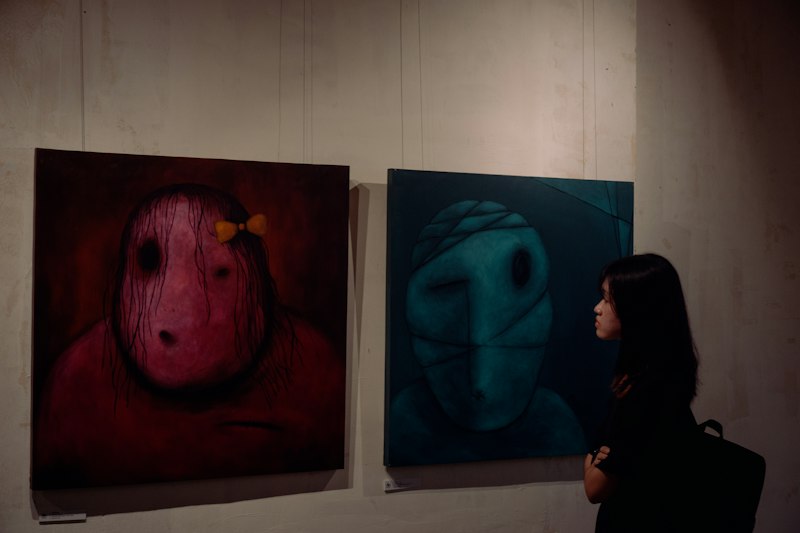
- Formal Distortion: The intentional or unintentional warping of recognizable forms or figures, symbolizing internal psychological states rather than external reality.
- Compositional Instability: A lack of classical balance or symmetry, often featuring skewed perspectives or elements that appear to be falling out of the frame, contributing to a feeling of unease or dynamic conflict.
These elements are not random; they are specific manifestations of the artist’s heightened physiological arousal. For example, increased heart rate and muscle tremor associated with acute anxiety or tension directly correlate with less controlled, more forceful movements on the canvas. The Expressionism Factor mathematically aggregates these individual stylistic indices, providing a singular score that quantifies the degree of affective projection present in the final work. This mechanism allows researchers to treat emotional content not as an interpretive guess, but as a measurable, embedded feature of the art object itself.
IV. A Practical Example: Analyzing Visual Art
To fully understand the Expressionism Factor, consider the practical analysis of two hypothetical oil paintings of a landscape. Painting A is executed by an artist known for meticulous realism and formal adherence, while Painting B is created by an artist undergoing a period of intense personal stress and emotional tension. A researcher using the Expressionism Factor methodology would analyze both works based on predefined stylistic criteria to assign a comparative score.
The analysis of Painting B, the work created under duress, would likely follow a step-by-step process demonstrating the application of the Expressionism Factor criteria:
- Line Quality Assessment: The researcher first observes the lines defining the forms (trees, horizon). Painting B exhibits jagged, fragmented, and heavily outlined shapes, contrasting sharply with the smooth, continuous lines of Painting A. This high degree of line turbulence scores highly on the factor.
- Color and Tone Analysis: The researcher notes that Painting B uses highly contrasting, almost jarring combinations of deep purples and aggressive yellows, often applied directly from the tube (high saturation), creating visual friction. This contributes significantly to the Expressionism Factor score, reflecting emotional intensity rather than naturalistic light.
- Texture and Application Study: Painting B shows thick, uneven impasto, suggesting the paint was applied quickly and forcefully with little blending, indicating physical urgency. Painting A, conversely, shows smooth, blended surfaces. The kinetic energy visible in Painting B’s texture is a strong indicator of the factor.
- Formal Synthesis and Scoring: After weighting these component scores (line, color, texture, distortion), the cumulative data indicates a significantly higher Expressionism Factor for Painting B. The conclusion drawn is that the measurable stylistic choices in Painting B strongly correlate with the artist’s internal state of tension and emotional conflict.
This example illustrates how the factor translates subjective emotional experience into objective, quantifiable data. By systematically breaking down the artwork into measurable stylistic components, the Expressionism Factor provides empirical evidence that the art serves as a direct, non-verbal conduit for Emotional expression, particularly when that expression is rooted in states of high psychological arousal.
V. Significance and Impact on Psychological Research
The Expressionism Factor holds profound significance for psychological research because it provides a crucial empirical bridge between the highly subjective world of artistic creation and the objective methodologies of science. Prior to such quantifiable constructs, discussions of emotional influence in art were largely speculative or reliant on biographical interpretation. The factor allows researchers to test hypotheses about the interaction between personality, psychopathology, and artistic output with statistical reliability. It validates the idea that art is not merely decoration or imitation, but a powerful, reliable projection system for the human psyche.
Its impact is particularly felt in the study of creativity and mental health. By isolating the dimension of expressive intensity, researchers can investigate whether certain personality traits correlate reliably with a tendency to externalize emotion through expressive style. For example, studies have utilized the factor to explore the art created by individuals struggling with mood disorders, schizophrenia, or high levels of chronic stress. Changes in an individual’s Expressionism Factor score over the course of treatment, or even across different life phases, can serve as a non-verbal indicator of underlying psychological shifts, offering a unique window into the stability or turbulence of their internal world.
Furthermore, the factor has influenced broader theories of perception. It confirms that viewers are sensitive to the energetic and emotional input embedded in stylistic choices, even if they cannot consciously articulate the source of their perception. This reinforces the concept that aesthetic experience is fundamentally a form of communication where the viewer subconsciously processes the kinetic and affective components of the artwork. By providing measurable dimensions for Emotional expression, the Expressionism Factor strengthens the position of aesthetics within mainstream empirical psychology.
VI. Applications in Therapy and Education
One of the most valuable practical applications of the Expressionism Factor lies in the field of clinical intervention, particularly in Art therapy. In a therapeutic setting, art creation is used as a primary means of communication for clients who may struggle to verbalize their deep-seated emotions or traumatic experiences. The Expressionism Factor provides the therapist with an objective, diagnostic tool to track the client’s internal state and therapeutic progress.
For instance, a client beginning therapy might produce works scoring very high on the factor, characterized by chaotic composition and aggressive lines, reflecting significant internalized conflict or acute psychological distress. As therapy progresses and the client develops better coping mechanisms, the therapist might observe a measurable reduction in the Expressionism Factor score in subsequent artworks—lines become softer, colors more integrated, and composition less turbulent. This quantitative change serves as empirical evidence of reduced internal tension and increased psychological integration, supplementing the qualitative observations made by the therapist.
In educational contexts, the factor is highly relevant for teaching art appreciation and critical analysis. Instead of relying solely on subjective critique, educators can use the principles underlying the Expressionism Factor to teach students how to identify and analyze the non-verbal communication of emotion embedded in artistic style. This demystifies the connection between the artist’s life and their work, providing students with analytical frameworks that move beyond simple preference to understand the psychological forces that shape artistic output, thereby fostering a deeper, more informed engagement with art history and contemporary practice.
VII. Connections and Related Concepts
The Expressionism Factor does not exist in isolation; it is deeply interwoven with several other major psychological theories and concepts, primarily stemming from the fields of cognitive psychology, personality theory, and the wider study of Emotional expression. Its closest conceptual relative is the psychological study of projective techniques, such as the Rorschach test or Draw-A-Person tests, where the individual’s unconscious thoughts and feelings are hypothesized to be projected onto an ambiguous stimulus or through their own spontaneous creation. The Expressionism Factor applies a rigorous, quantitative lens to this inherently projective process.
Furthermore, the factor is closely linked to trait theories of personality. Specifically, high factor scores often correlate positively with the trait of Neuroticism (indicating emotional instability or high anxiety) and certain aspects of Openness to Experience (the tendency to be imaginative and sensitive to inner feelings), providing a visual, external correlate for internal psychological dispositions. The Expressionism Factor serves as an observable manifestation of the individual differences in how people process and externalize intense affect.
Finally, it fits within the broader category of Social and Affective Neuroscience, which examines the neural bases of emotion and communication. As research continues to explore how motor systems and emotional centers interact, the Expressionism Factor offers a behavioral measure for testing hypotheses regarding the neurophysiological translation of emotional arousal into motor output. By focusing on the quantifiable stylistic markers of internal states, the factor solidifies the position of Psychological Aesthetics as a vital subfield linking emotion, cognition, and physical behavior.