Kantian Ethics: The Hidden Psychology of Moral Duty
Scientifically Reviewed · Dr. Marwa Abd-Alazim · September 19, 2026
Review Criteria & Clinical Standards
This content undergoes rigorous scientific peer-review and medical editorial standards at Arab Psychology Network to ensure clinical accuracy, validity, and compliance with evidence-based guidelines from leading psychological and healthcare authorities (APA / WHO).
Historical Context and Core Definition of Kantianism
Kantianism represents a profound and enduring philosophical system originating from the rigorous work of the German Enlightenment philosopher, Immanuel Kant (1724–1804). Widely regarded as the foundational framework of modern moral philosophy, Kantianism shifts the focus of ethical inquiry away from theological mandates or empirical consequences toward the internal structure of rational thought itself. At its core, Kantian ethics posits that moral decisions must be grounded in an understanding of universal moral principles, which Kant meticulously argued could be derived purely from the inherent capabilities and architecture of human reason. This approach firmly establishes morality not as a matter of subjective feeling or external reward, but as an objective necessity binding upon all rational agents, irrespective of their desires or cultural context.
The philosophical landscape prior to Kant was dominated by either empiricist approaches, which grounded morality in experience (like Hume’s emphasis on sentiment), or earlier rationalist traditions that often struggled to provide a non-arbitrary basis for moral law. Kant sought to synthesize these traditions by performing a critical examination of reason, arguing that while experience informs us of the world, pure practical reason dictates how we ought to act within it. Kantianism fundamentally elevates the concept of autonomy—the capacity of individuals to legislate the moral law for themselves—as the central precondition for moral action. Unlike systems where moral rules are externally imposed, Kant insists that genuine morality requires the free and self-directed will of the agent, acting not out of compulsion or desire, but solely out of respect for the moral law recognized through reason.
Therefore, the definition of Kantianism rests upon the premise that the moral worth of an action is determined entirely by the maxim (the principle or rule) upon which the action is based, rather than the desirability of its outcome. A central concern for Kant was the distinction between acting merely in conformity with duty and acting from duty. Only actions performed purely out of respect for the moral law possess genuine moral value. This rigid adherence to rational principle, independent of inclination or anticipated results, provides the necessary stability and universality that Kant believed was essential for any robust system of ethics, ensuring that moral laws apply equally and consistently to all rational beings.
The Role of Reason and the Good Will
The entire structure of Kantian ethics is predicated upon the supremacy of practical reason. Kant distinguished between theoretical reason, which seeks to understand the world as it is, and practical reason, which dictates how the world ought to be shaped by our actions. For Kant, morality is not discovered through observation of human behavior, which is often flawed and inconsistent, but is legislated by the internal demands of reason itself. When an individual acts morally, they are essentially exercising their capacity as a rational being, demonstrating freedom from the deterministic forces of nature and instinct. Morality is thus understood as a necessary implication of rationality; a truly rational being must also be a moral being.
The foundational concept in Kant’s moral theory is the notion of the Good Will. Kant famously asserted in the Groundwork of the Metaphysics of Morals (1785) that the Good Will is the only thing that is good without qualification. Intelligence, wit, wealth, or happiness can all be used for evil purposes or be corrupted by circumstance; however, the Good Will remains intrinsically valuable regardless of whether its efforts succeed or fail in the empirical world. The Good Will is not defined by its accomplishments but by its resolve—it is the fixed determination to do one’s duty purely because it is one’s duty, acting according to the principle of moral law recognized by reason.
This emphasis on the Good Will highlights Kant’s focus on motivation and intention. The moral quality of an action resides solely in the agent’s volition. If an action, such as giving charity, is performed solely to enhance one’s reputation or garner emotional satisfaction, it may conform to duty, but it lacks genuine moral worth in the Kantian sense. Conversely, an action performed out of pure respect for the moral law, even if it leads to an unintended negative outcome, retains its moral value because the intention was correctly aligned with the dictates of reason. This internal commitment to principle is what distinguishes moral action from mere accidental congruence with moral rules.
Furthermore, practical reason provides the mechanism for deriving the moral law. Kant believed that because reason is universal—all rational beings possess it—the moral laws derived from it must also be universal and necessary. This universality is crucial because it ensures that moral requirements are not merely conventional, arbitrary, or culturally specific, but are objectively binding commands. The test of any moral action, therefore, lies in whether the rational agent can consistently will the principle behind that action to become a universal law governing everyone, thereby establishing a system of impartial ethical legislation.
Understanding the Moral Law: The Categorical Imperative
Kantianism is famously built upon the concept of the Categorical Imperative. This imperative represents the ultimate and universal moral law that applies unequivocally to all rational beings, regardless of their personal goals, desires, or circumstances. Kant distinguished the Categorical Imperative from Hypothetical Imperatives, which command an action only as a means to achieve some desired end (e.g., “If you want to pass the exam, then you must study”). Hypothetical imperatives are conditional, pragmatic, and prudential; they tell you what you must do to achieve happiness, success, or any other contingent goal.
The Categorical Imperative, however, commands actions that are necessary in themselves, objectively and without reference to any further purpose. It is a command of reason that states, essentially, “You ought to do Y,” where Y is morally necessary and good in itself. This structure ensures that moral obligations are not contingent upon individual inclinations or empirical outcomes. Kant argued that the moral law must be categorical because if it were hypothetical, morality would dissolve into mere expediency, dependent on what an individual happened to desire at a given moment, stripping moral commands of their required necessity and universality.
The fundamental function of the Categorical Imperative is to serve as a test for the moral acceptability of our maxims. A maxim is the subjective principle of action, capturing the rule or reason behind a specific act, usually expressed as “When I am in situation X, I will do Y to achieve Z.” When a rational agent decides to act, they are implicitly adopting a maxim. The Categorical Imperative then demands that one must always act only in such a way that the maxim underlying one’s actions could be willed as a universal law, applying consistently to everyone, everywhere, without resulting in a logical contradiction or undermining the possibility of rational agency.
If applying the maxim universally leads to a logical contradiction (a contradiction in conception, meaning the practice would destroy itself, as with making a lying promise) or a contradiction in the will (meaning no rational person could consistently desire a world governed by that maxim), the maxim is morally unacceptable, and the action based upon it is morally forbidden. This rigorous test of universalizability ensures that moral decisions transcend personal interests and are grounded in impartiality and shared rationality, making the Categorical Imperative the supreme principle of morality.
Key Formulations of the Categorical Imperative
While the Categorical Imperative is a single, unified moral law, Kant presented several different ways of expressing it, known as formulations, which serve to illuminate distinct facets of moral obligation and its application. The first and most commonly cited formulation is the Formula of Universal Law: “Act only according to that maxim whereby you can at the same time will that it should become a universal law.” This formulation emphasizes the necessity of checking our principles of action against the standard of consistency and universality, demanding that we step outside our self-interest to view our maxims objectively as if they were laws of nature.
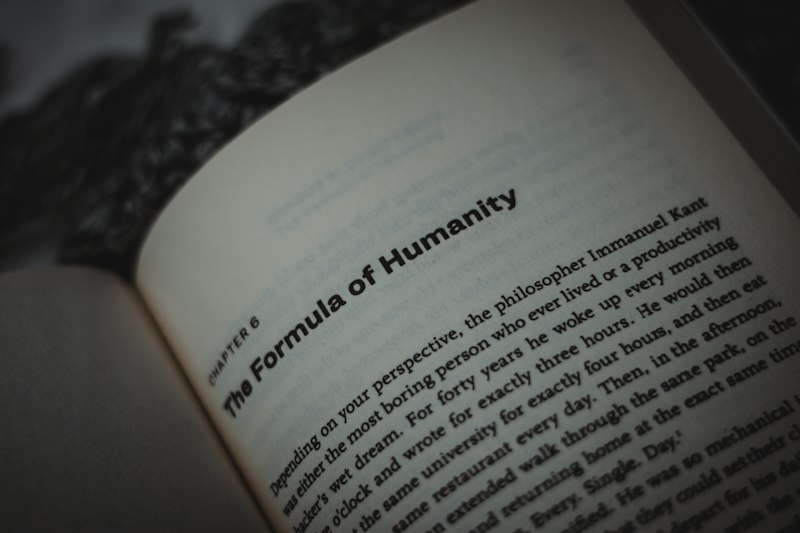
The second crucial formulation is the Formula of Humanity as an End in Itself: “Act in such a way that you treat humanity, whether in your own person or in the person of any other, never merely as a means to an end, but always at the same time as an end.” This formulation introduces the concept of dignity and intrinsic worth. Rational beings, unlike mere objects or resources, possess unconditional value because of their capacity for rational autonomy and moral self-legislation. To treat someone merely as a means is to disregard their status as a rational agent capable of setting their own goals and making their own choices. For instance, enslavement, coercion, or deception are fundamentally immoral because they strip the victim of their agency, using them solely as a tool for the perpetrator’s goals.
A third significant formulation is the Formula of Autonomy (or Kingdom of Ends): “Act in accordance with the maxims of a member legislating universal laws for a merely possible kingdom of ends.” This formulation synthesizes the previous two by envisioning a moral community—the Kingdom of Ends—where every member is simultaneously a law-maker (autonomous) and subject to the laws they create. This framework underscores the idea that morality requires us to act as if we are creating laws for a perfectly rational society, emphasizing the necessity of impartiality, mutual respect, and the compatibility of all individual maxims within a universal moral system. All rational agents must respect the legislative authority of all other rational agents.
Duty, Autonomy, and Moral Worth
The concept of duty (Pflicht) holds a central, non-negotiable position within Kantian ethics. Duty refers to the necessity of acting out of respect for the moral law. For Kant, morality is not about achieving happiness or satisfying desires; it is about fulfilling one’s obligations as a rational being, recognizing the Categorical Imperative as a binding command. This means that a truly moral action is one performed solely because the agent recognizes it as required by the moral law, independent of any potential emotional satisfaction, personal gain, or external benefit derived from the act.
This rigorous emphasis on duty is intrinsically linked to the concept of autonomy. Kantian autonomy is not mere freedom to act capriciously; rather, it is the capacity of the rational will to be a law unto itself. When an agent acts morally, they are obeying a law that they themselves, as a rational being, have legislated and affirmed through reason. This self-legislation ensures that moral obligations are not heteronomous (imposed externally, whether by God, society, or base desire), but spring from the agent’s own rational nature, confirming the individual’s profound responsibility for their moral choices. To act autonomously is to act according to a principle that one could rationally will to be a universal law.
Kant further differentiated between perfect duties and imperfect duties. Perfect duties are those that admit no exception; they are strictly required and often prohibit specific actions (e.g., the duty not to lie, the duty not to commit murder, the duty to keep promises). If the maxim underlying a perfect duty is universalized in its contradictory form (e.g., “I will always lie when convenient”), a contradiction in conception results, making the principle rationally impossible. Imperfect duties, conversely, allow for some leeway in how and when they are fulfilled (e.g., the duty to cultivate one’s talents, the duty to help others). Universalizing the maxim contrary to an imperfect duty results in a contradiction in the will, meaning a rational person could not consistently desire a world where no one ever helped others, as they might need help themselves.
The moral worth of an action, therefore, is directly proportional to the extent to which it is motivated by duty and reason, rather than inclination. Kantianism stresses that the moral agent must perform the duty precisely because it is the moral law, thereby distinguishing mere conformity to duty (performing the right action for the wrong reason, like a shopkeeper giving correct change only to maintain a good reputation) from acting from duty (performing the right action for the sole reason that it is morally required). It is this internal commitment to the moral law that grants an action its true ethical character, making Kantian ethics fundamentally an ethics of motivation.
Kantianism versus Consequentialism
Kantianism stands in stark contrast to consequentialist theories, most notably utilitarianism. Utilitarianism, championed by thinkers like Jeremy Bentham, asserts that the moral value of an action is determined entirely by its consequences—specifically, the action that produces the greatest happiness or “greatest good for the greatest number” is the morally correct choice. This framework is teleological, meaning it focuses on the end goal and evaluates actions based on their instrumental effectiveness in achieving a desirable state of affairs.
Kantianism, conversely, is a deontological system, meaning it holds that certain actions are intrinsically right or wrong based on the moral principle underlying them, independent of their outcomes. For Kant, the intention, guided by rational duty, is paramount. A Kantian argues that lying is always morally wrong because the maxim “I will lie when it suits my needs” cannot be universalized without destroying the concept of trustworthy communication itself, regardless of whether a particular lie might produce a positive outcome, such as preventing harm. The moral quality is fixed in the act’s principle, not its result.
This fundamental disagreement leads to vastly different prescriptions in ethical dilemmas. A utilitarian might justify the sacrifice of one innocent person if it saved the lives of ten others, arguing that the overall net happiness is maximized, thereby adhering to the principle of utility. A Kantian, however, would strongly reject this conclusion, citing the Formula of Humanity, which forbids treating any person merely as a means to the ends (happiness) of others. The individual possesses absolute moral worth that cannot be overridden by collective utility; rights are absolute and non-negotiable under Kantian law.
Therefore, while utilitarianism places emphasis on the external, measurable results of an action, Kantianism places emphasis on the internal, rational motivation and the importance of autonomy in moral decision-making. Kant viewed reliance on consequences as inherently unstable and morally compromising, arguing that since consequences are often unpredictable and outside the control of the agent, moral worth must reside in the one thing the agent can control: the will to act according to rational law and duty. Moral responsibility must be located in the controllable aspect of action—the maxim—and not the uncontrollable outcome.
Enduring Influence and Contemporary Applications
Kantianism has proven to be extraordinarily influential, shaping much of modern political philosophy, legal theory, and biomedical ethics. Its rigorous defense of the individual and universal rights provides a powerful counterpoint to theories that might allow for the suppression of minority rights in favor of majority interests. Many contemporary philosophers, recognizing the power and stability of the Kantian framework, have incorporated elements of its structure into their own theories, viewing it as essential for establishing objective moral boundaries.
A prime example is the work of John Rawls, whose seminal work, A Theory of Justice (1971), utilized a constructivist approach deeply inspired by Kant. Rawls’s conception of the “Original Position” and the “Veil of Ignorance” are designed to generate principles of justice that are impartial, universal, and rationally necessary—mirroring Kant’s project of deriving moral law from pure practical reason, independent of contingent desires or social status. Similarly, thinkers like Peter Singer, while often working within a utilitarian tradition, have engaged deeply with Kantian concepts, particularly concerning the treatment of rational beings and the moral weight of personhood in applied ethics.
Furthermore, Kantian ethics offers powerful tools for analyzing complex contemporary moral issues. In the realm of biomedical ethics, the Formula of Humanity provides a strong argument against practices like non-consensual medical experimentation, forced sterilization, or euthanasia without fully informed consent, as these actions inherently violate the subject’s autonomy by treating them as mere biological resources rather than rational beings with dignity. The application of universalizability is also crucial in public policy debates surrounding issues such as abortion, the ethics of war, and same-sex marriage, forcing advocates to ground their positions in principles that could consistently be willed as universal law for all rational agents, promoting impartiality and fairness.
In summary, the enduring legacy of Kantianism lies in its unwavering commitment to the inherent dignity of the person, its insistence on universal and impartial moral standards, and its elevation of rational autonomy as the source and measure of true moral action. By grounding morality in reason rather than sentiment or consequence, Kant provided a robust, rigorous, and often demanding ethical framework that continues to be central to philosophical discourse and practical moral deliberation today, ensuring that morality remains a matter of principle over expediency.
Selected Bibliography
The following references represent key primary and secondary sources foundational to the study and modern application of Kantian philosophy and related ethical debates.
- Bentham, J. (1789). An introduction to the principles of morals and legislation. Oxford: Clarendon Press.
- Kant, I. (1785). Groundwork of the metaphysics of morals. Cambridge: Cambridge University Press.
- Rawls, J. (1971). A theory of justice. Cambridge, MA: Harvard University Press.
- Singer, P. (2009). The life you can save: Acting now to end world poverty. New York: Random House.