Tag: diagnostic tools


RADIOACTIVE TRACER

The Conceptual Foundation of Radioactive Tracers in Psychology In the expansive field of neuropsychology and behavioral neuroscience, the radioactive tracer serves as a fundamental tool for visualizing the invisible biological processes that underpin human cognition and emotion. A radioactive tracer, also frequently referred to as a radiopharmaceutical or radioligand, is a chemical compound in which […]

Read More

MILLON CLINICAL MULTIAXIAL INVENTORY (MCMI)

Introduction and Conceptual Foundation The Millon Clinical Multiaxial Inventory (MCMI) is recognized as one of the most prominent and theoretically grounded psychological assessment instruments specifically developed for use with clinical populations. Designed by the esteemed psychologist Dr. Theodore Millon, the MCMI is unique because its structure and scales are explicitly aligned with a comprehensive and […]

Read More

ACUITY GRATING

Introduction to Acuity Gratings and Visual Acuity The concept of the acuity grating serves as a cornerstone in modern visual psychophysics, providing a precise and standardized method for quantifying the resolution capabilities of the human and animal visual system. Unlike traditional measures of visual acuity, such as the Snellen chart, which rely on identifying complex, […]

Read More

OPHTHALMOSCOPE

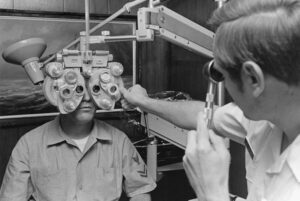
Introduction and Definitional Framework The ophthalmoscope is a critical diagnostic instrument utilized universally in the fields of ophthalmology, optometry, and general medicine. Functionally defined, it is a specialized, often hand-held gadget engineered to permit the visualization and analysis of the internal structures of the eye, particularly the ocular fundus. The fundus encompasses the retina, the […]

Read More

AUTOSCOPE

Introduction and Definitional Framework The term autoscope, within the specialized lexicon of psychophysiology and kinesiology, denotes a sophisticated analytical instrument specifically engineered for the detection, recording, and subsequent magnification of minute muscular movements. These movements, often referred to as micromovements or subtle motoric oscillations, are frequently imperceptible to the unaided human eye, yet they hold […]

Read More

OBJECT-ASSEMBLY TEST

Introduction to the Object-Assembly Test The Object-Assembly Test, commonly abbreviated as OAT, represents a classic and foundational component within the field of psychometric evaluation, specifically designed to gauge an individual’s non-verbal reasoning capabilities, visual-spatial organization, and capacity for synthetic processing. Fundamentally, the examination requires the subject to reconstruct a complex, broken-up stimulus—typically a recognizable object […]

Read More

DIAGNOSTIC INTERVIEW SCHEDULE (DIS)

Introduction and Definition of the DIS The Diagnostic Interview Schedule (DIS) is a highly formalized, structured psychiatric interview designed specifically for use in large-scale epidemiological studies and clinical research settings. It stands as a landmark achievement in psychometrics, representing a crucial shift from relying solely on unstructured, subjective clinical interviews toward objective, reproducible diagnostic assessment. […]

Read More

PSEUDOISOCHROMATIC CHARTS

Introduction to Pseudoisochromatic Charts The Pseudoisochromatic Chart, frequently abbreviated as a PIC, constitutes one of the most fundamental and widely employed screening tools utilized in both clinical ophthalmology and experimental psychology for the detection of inherited color vision deficiencies. These charts are meticulously designed to exploit the specific manner in which individuals with impaired color […]

Read More

PAIN DRAWING

Defining the Pain Drawing Instrument The Pain Drawing is recognized within clinical psychology and physiatry as a potent visual-spatial diagnostic tool utilized for discerning the quantity, seriousness, and specific form or quality of a patient’s pain experience. Unlike standard verbal rating scales which rely solely on linguistic articulation, the Pain Drawing provides a topographical map […]

Read More

SCID-II

Introduction and Definition of SCID-II The acronym SCID-II stands for the Structured Clinical Interview for DSM-IV Axis II Personality Disorders. This instrument is a cornerstone in the field of clinical psychology and psychiatry, serving as a standardized diagnostic tool designed to systematically assess the presence of the ten specific personality disorders delineated in the Diagnostic […]

Read More

ADAPTOMETER

Introduction and Definition The adaptometer is a specialized psychophysical instrument meticulously designed to quantify the rate and extent of visual adaptation, particularly the process known as dark adaptation. This critical apparatus allows researchers and clinicians to measure precisely how long it takes for the human visual system to recover sensitivity after exposure to bright light, […]

Read More

PNEUMOGRAPH

Definition and Etymology The pneumograph is a sophisticated physiological instrument utilized to document the mechanical motions or volumetric alterations of the lungs and chest wall associated with the process of respiration. Functionally, it operates as a specialized transducer, converting the relatively small physical displacements of the respiratory apparatus into quantifiable electrical signals suitable for recording […]

Read More

MULTILINGUAL APHASIA EXAMINATION (MAE)

Introduction and Purpose of the Multilingual Aphasia Examination (MAE) The Multilingual Aphasia Examination (MAE) is recognized globally as a critical, standardized assessment tool primarily rooted in neurological principles, designed specifically to evaluate language function following acquired brain injury. Its fundamental purpose is twofold: first, to definitively determine the presence of aphasia, which is the impairment […]

Read More

RENARD DIAGNOSTIC INTERVIEW

Renard Diagnostic Interview The Core Definition of the Renard Diagnostic Interview (RDI) The Renard Diagnostic Interview (RDI) is recognized within clinical and research settings as a highly specialized and comprehensive structured diagnostic tool engineered to systematically assess the presence, severity, and history of a wide spectrum of psychiatric disorders. Unlike purely subjective clinical evaluations, the […]

Read More

BIOCHEMICAL MARKER

Biochemical Markers in Psychology and Neuroscience The Core Definition: Biochemical Markers in Mental Health Biochemical markers (BCMs) are quantifiable biological molecules found in accessible samples—such as serum, urine, saliva, or cerebrospinal fluid—that serve as indicators of normal biological processes, pathogenic processes, or pharmacologic responses to therapeutic intervention. While initially developed and primarily utilized in general […]

Read More