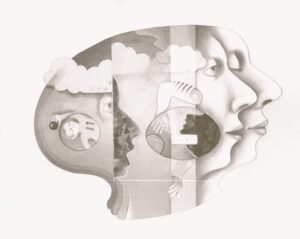
Tag: Symbolism


SYMBOLIC

Introduction to Symbolic Interactionism The sociological and social psychological framework known as symbolic interactionism offers a profound perspective on how human beings construct, negotiate, and maintain meaning through their everyday interactions. At its core, this theoretical lens posits that human behavior is not merely an automatic response to external, objective stimuli. Instead, individuals act based […]

Read More

SYMBOLISM

Definition and Scope of Symbolism Symbolism, at its most fundamental level, refers to the practice of representing abstract ideas or concepts through the use of objects, figures, words, or actions that stand for something other than their literal selves. This process is essential to human cognition and communication, allowing for the conveyance of complex meaning […]

Read More

CONDENSATION

Definition and Etymology Condensation, in the context of psychoanalytic theory, is defined as a fundamental psychological process wherein multiple disparate ideas, complex feelings, diverse concepts, or chains of association are systematically compressed and integrated into a single, unified image, symbol, or representation. This intricate mental operation serves as a primary mechanism by which the highly […]

Read More

PHALLIC SYMBOL

Introduction and Definition The term phallic symbol refers broadly to any object, image, or structure that bears a resemblance to, or can be interpreted as representing, the male sexual organ, the penis. This symbolic association is rooted in the physical characteristics of the phallus, primarily its elongated shape, vertical orientation, and inherent implications of power, […]

Read More

SYMBOLIC REPRESENTATION

Introduction to Symbolic Representation Symbolic representation stands as a cornerstone concept in cognitive psychology, philosophy, and linguistics, referring fundamentally to the process by which complex mental processes, internal states, and abstract ideas are expressed, communicated, or stored using conventional signs or symbols. This critical cognitive ability allows the human mind to transcend immediate sensory experience, […]

Read More

SYMBOL

Definition and Scope of the Symbol A symbol is fundamentally an idea, element, or picture that represents or exemplifies another concept, object, or abstract idea. It functions as a substitute or proxy for something else, allowing complex meaning to be conveyed efficiently across various contexts. Unlike a simple sign, which often possesses a direct, causal […]

Read More

PERSONIFICATION

The Definition and Scope of Personification The concept of personification, derived from the Latin persona (mask, character) and facere (to make), is highly multifaceted, encompassing linguistic, rhetorical, psychological, and sociological applications. Fundamentally, personification involves attributing characteristics, qualities, or actions typically associated with human beings—such as thoughts, emotions, intentions, or speech—to inanimate objects, abstract concepts, or […]

Read More

ANAGOGIC INTERPRETATION

Defining the Anagogic Interpretation The Anagogic Interpretation stands as a foundational concept within analytical psychology, primarily associated with the theoretical framework developed by Carl Jung and later systematized by Herbert Silberer. This method shifts the focus of interpreting subconscious material—such as dreams, fantasies, and symbolic expressions—away from a merely causal or reductive explanation toward a […]

Read More

PHALLICISM

Definition and Conceptual Framework of Phallicism Phallicism is fundamentally defined as the formal or informal reverence for the genitals of a male, particularly when these organs are viewed not merely in their physiological capacity, but as powerful symbols representing the creative forces of nature, generative power, or vital cosmic energy. This concept transcends simple sexual […]

Read More

TYPING

Introduction to the Concept of Typing in Psychology The term typing, within the context of psychological study, is highly polysemous, encompassing three distinct yet interrelated domains: cognitive categorization, social-developmental assignment, and complex psychomotor skill acquisition. Fundamentally, typing refers to the process of acknowledging, classifying, or performing according to a specific, often standardized, category or model. […]

Read More

SEMANTIC PSYCHOSIS

Semantic Psychosis: An Encyclopedia Entry The Core Definition and Manifestation Semantic psychosis is defined as a rare and often under-recognized mental disorder characterized fundamentally by severe disturbances in the perception and processing of meaning, affecting words, concepts, and symbols. Unlike typical forms of psychosis where the primary disturbances involve perception (hallucinations) or fixed false beliefs […]

Read More

SYMBOLIC FUNCTION

Symbolic Function Introduction to Symbolic Function The concept of symbolic function, often referred to as semiotic function, stands as a cornerstone in the study of human cognition and development. At its core, symbolic function is the profound human ability to use one thing — a symbol — to stand for, or represent, another. This capacity […]

Read More