Crowd Psychology: Decoding the Collective Mind
Scientifically Reviewed · Dr. Marwa Abd-Alazim · August 25, 2026
Review Criteria & Clinical Standards
This content undergoes rigorous scientific peer-review and medical editorial standards at Arab Psychology Network to ensure clinical accuracy, validity, and compliance with evidence-based guidelines from leading psychological and healthcare authorities (APA / WHO).
Definition and Conceptual Scope of the Crowd
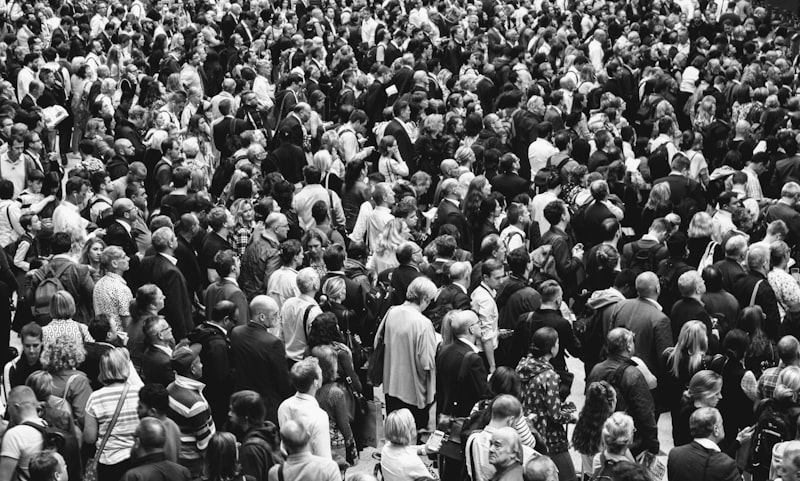
The term “crowd,” within the context of psychological and sociological inquiry, designates a large collection of individuals who are physically co-present in a single, defined locale and who transitorily share a joint concentration or focus of attention. This definition emphasizes three critical, necessary conditions: the sheer magnitude of participants, the spatial proximity (or co-presence) of those individuals, and the temporal nature of the assembly—meaning the shared experience is inherently brief or impermanent. Crucially, a crowd differs significantly from a standing social group in that its formation is typically spontaneous or organized around a singular, immediate event or stimulus, rather than sustained relational ties or established organizational structures. The shared locale and the resulting mutual awareness of co-presence are foundational to understanding the psychological shifts that characterize crowd behavior.
The psychological atmosphere engendered by a crowd is often described by the concept of circular reaction, where the emotional state of one individual quickly influences and is amplified by the emotional states of others in a rapid feedback loop. This intense, shared emotionality differentiates the crowd from a mere aggregate of people who happen to occupy the same space without common focus, such as passengers waiting in a sprawling airport terminal. The shared focus might be a political protest, a sporting event, a celebratory concert, or an emergency situation like a fire. Regardless of the stimulus, the immediate physical proximity facilitates the rapid transmission of affect and information, leading to the potential for unified, often intense, collective action or expression.
Understanding the crowd requires acknowledging the distinction between the physical entity and the psychological state it induces. While the physical definition relies on numbers and location, the psychological definition hinges on the erosion of individual differences and the emergence of a collective mentality, however transient. This psychological convergence is what fascinated early theorists, who sought to explain why individuals, acting within the context of a crowd, might behave in ways contrary to their typical rational or moral frameworks. Therefore, the study of crowds is fundamentally the study of social influence operating under conditions of high density and shared attention, exploring how individual decision-making is temporarily suspended in favor of emergent collective norms.
Historical Context and Early Theories of the Group Mind
The systematic psychological study of the crowd began prominently in the late 19th century, driven by the social upheavals following the industrial revolutions and the rise of mass democracy. The foundational text in this area is widely considered to be Gustave Le Bon’s 1895 work, Psychologie des Foules (The Crowd: A Study of the Popular Mind). Le Bon posited that when individuals assemble into a crowd, they form a single psychological entity—the group mind or âme de la foule—which possesses distinct characteristics markedly different from the individuals composing it. Le Bon argued that this group mind was characterized by intellectual regression, impulsiveness, irritability, exaggeration of sentiment, and the incapacity for sustained reason, painting a largely negative picture of the collective.
Le Bon’s theory introduced three core psychological mechanisms believed to operate within the crowd: anonymity, contagion, and suggestibility. Anonymity, resulting from the sheer size of the assembly, leads to a reduction in personal responsibility and accountability. Contagion describes the rapid spread of emotions and actions, mimicking a biological infection, allowing collective moods to take hold instantaneously. Suggestibility refers to the heightened state in which crowd members become highly susceptible to the influence of a leader or external stimulus, often acting upon irrational or impulsive suggestions. While heavily criticized today for its anti-democratic and elitist undertones, Le Bon’s framework established the initial parameters for studying the transformation of the individual personality within the collective setting, influencing subsequent political philosophy and social psychology for decades.
Contemporaneous with Le Bon, Gabriel Tarde offered a contrasting but equally influential perspective, emphasizing the role of imitation rather than contagion. Tarde viewed society as fundamentally based on hypnotic suggestion and the imitation of superior individuals or models. While Le Bon focused on the physical crowd as the breeding ground for irrationality, Tarde extended his analysis to the “public,” a more dispersed social entity unified by shared media (such as newspapers). Despite their theoretical differences—Le Bon prioritizing the immediate physical assembly and Tarde focusing on mediated influence—both theories underscored the profound power of non-rational mechanisms (suggestion, imitation) to shape collective behavior, laying the groundwork for modern social psychological theories of normative influence and social identity.
Typologies and Classification of Crowds
Modern research has moved beyond the monolithic concept of the “irrational mob” proposed by early theorists, recognizing that crowds are highly diverse and vary significantly in purpose, structure, and intensity. Sociologists and psychologists typically classify crowds based on their primary activity or emotional disposition, acknowledging that different types of crowds pose distinct challenges and exhibit unique behavioral patterns. These classifications help researchers predict the trajectory of collective events and inform strategies for crowd management and public safety, moving from passive assemblies to actively engaged groups capable of instrumental action.
A common classification system distinguishes four main types, ordered roughly by their level of activity and emotional intensity:
- Casual Crowds: These are the least organized and most transitory, characterized by individuals who happen to be in the same place at the same time, such as shoppers in a mall or people observing a minor street accident. Interaction is minimal, and the shared focus is fleeting.
- Conventional Crowds: These crowds gather for a planned event that follows established norms and procedures, such as attendees at a lecture, a religious service, or a theatrical performance. Behavior is regulated by social expectations, and the focus is highly organized.
- Expressive Crowds: The primary purpose of these crowds is emotional release or expression. Examples include crowds at festivals, rock concerts, or large celebratory gatherings. The atmosphere is highly charged, and the behavior is often spontaneous, though generally non-violent.
- Acting Crowds: These are goal-oriented crowds focused on achieving a specific objective, often involving highly charged emotional states and the potential for collective action, whether destructive (riots, panics) or constructive (protests, rescues). This category is where the concept of the “mob” traditionally resides.
Furthermore, a crucial distinction exists between crowds that engage in milling—a preparatory phase where individuals move around and communicate, building emotional intensity and shared focus—and those that engage in instrumental action aimed at external goals. Understanding these types allows analysis to shift from merely observing chaos to understanding the structure and function inherent in different collective assemblies. The transition from an expressive crowd to an acting crowd, for instance, often occurs when environmental conditions or external stimuli transform shared emotion into a shared sense of grievance or opportunity for immediate action.
Mechanisms of Contagion and Suggestibility
The core psychological challenge in studying crowds lies in explaining the rapid and often homogeneous adoption of behaviors and emotional states. The mechanisms of contagion and suggestibility provide the primary theoretical tools for this explanation. Emotional contagion refers to the rapid, unconscious spread of emotions, attitudes, and behaviors from person to person, functioning as a powerful synchronizing force within the collective. This process is often non-cognitive; individuals do not necessarily process the emotion rationally but rather mirror the affective states observed in those around them, a process potentially linked to fundamental human neurological systems like mirror neurons.
In the dense environment of a crowd, the visual and auditory inputs are overwhelming, magnifying the perceived intensity of emotions such as fear, anger, or excitement. This shared, escalating affect creates a powerful sense of collective effervescence, a term coined by sociologist Émile Durkheim, describing the feeling of shared, heightened energy that binds individuals together and elevates them beyond their mundane existence. This effervescence dramatically increases suggestibility. Suggestibility, in this context, is the tendency for individuals to uncritically accept and act upon ideas, beliefs, or courses of action proposed by others, particularly leaders or highly visible members of the crowd, or arising from the general mood.
The interplay between contagion and suggestibility is central to the development of collective action. Contagion establishes the shared emotional baseline (e.g., widespread fear or anger), while suggestibility directs that emotion toward a specific target or action (e.g., fleeing in a panic or attacking a perceived enemy). This process is facilitated by the reduction of critical thought, often cited by Le Bon, but modern perspectives emphasize that it is not necessarily a regression to a primitive state. Instead, it is a temporary shift in cognitive focus, where the need for rapid interpretation of an ambiguous, high-stakes situation overrides careful, individual deliberation. Consequently, information—or misinformation—spreads with exceptional speed and force, often leading to unreflective collective responses that can escalate quickly into panics or riots.
Deindividuation and the Shift to Social Identity
The concept of deindividuation is a cornerstone of modern crowd psychology, explaining the mechanisms by which individuals lose self-awareness and personal accountability when immersed in a large group. Introduced formally by Leon Festinger, Albert Pepitone, and Theodore Newcomb in 1952, and later elaborated by Philip Zimbardo, deindividuation theory posits that the anonymity provided by the crowd, combined with shared attention and high arousal, leads to a weakening of internal constraints and a reduced focus on personal standards of behavior. The individual shifts their attention away from self-monitoring and toward the immediate environment and the collective action, increasing the likelihood of engaging in behaviors that would normally be inhibited.
However, the purely negative view of deindividuation—suggesting it only leads to anti-social or aggressive behavior—has been significantly revised by the Social Identity Model of Deindividuation Effects (SIDE). The SIDE model argues that the observed behavioral changes are not due to a loss of identity per se, but rather a shift from personal identity (based on unique characteristics) to a social identity (based on group membership). When individuals deindividuate within a crowd, they become more attuned to the norms, values, and goals of that specific collective identity. If the crowd identity is anti-social (e.g., a violent mob), then anti-social behavior increases. If the crowd identity is prosocial (e.g., protesters defending a vulnerable person), prosocial behavior increases.
This social identity perspective is crucial because it provides a more nuanced understanding of why crowds do not always descend into chaos. The behavior of a crowd is not merely an expression of suppressed individual aggression; rather, it is highly structured by the emergent norms and shared social categories that define the assembly. Empirical research, particularly concerning collective protests, demonstrates that crowd behavior is highly predictable based on the political and moral identities held by the participants and the perceived legitimacy of the authorities present. Therefore, the psychological transformation within the crowd is best understood as a potent alignment of individual actions with the immediate, context-specific goals and norms of the temporary collective identity.
Collective Action, Mobilization, and the Structure of Riots
When crowds transform into acting collectives, often taking the form of protests or riots, the analysis shifts to collective action theory. These events are rarely random outbursts of irrationality; instead, they represent complex social phenomena rooted in political, economic, and social grievances. Mobilization theory emphasizes that collective action requires not only shared discontent but also resources, organization, and a sense of political efficacy—the belief that action can actually effect change. The crowd serves as the immediate vehicle for expressing these grievances and coordinating action against a perceived injustice or opposition.
Riots, a highly destructive form of collective action, are often misunderstood as purely chaotic events. However, research into the structure of riots reveals that they are typically highly localized and exhibit specific, often instrumental, targets. Targets are rarely random; they usually reflect symbols of authority, economic exploitation, or perceived oppression. The initial trigger for a riot is often a seemingly minor incident—the “spark”—that ignites pre-existing, widespread tension. This spark, coupled with the dense co-presence of individuals sharing the same sense of injustice, facilitates the rapid development of collective identity and a willingness to violate established social order.
Furthermore, the concept of emergent norm theory suggests that during collective episodes, new, temporary standards of behavior quickly develop and govern the actions of participants. In a riot, for instance, norms might emerge defining which property is acceptable to damage (e.g., police cars, corporate chains) and which is not (e.g., local residences or small businesses). These norms ensure a degree of internal consistency and purpose, even during periods of intense violence, demonstrating that collective behavior remains subject to situational social regulation rather than pure anarchy. The study of collective action thus focuses heavily on the communication, coordination, and shared interpretations of reality that mobilize the crowd toward a unified, specific goal.
Modern Perspectives: The Digital and Virtual Crowd
The advent of digital communication technologies has profoundly complicated and expanded the traditional definition of the crowd, which was strictly tied to physical co-presence. The rise of social media platforms, online forums, and massive multiplayer virtual environments has given birth to the concept of the virtual crowd or digital collective. While these groups lack physical co-presence, they share the critical elements of joint concentration, rapid emotional contagion, and the potential for coordinated action. Events like flash mobs, organized entirely online but executed physically, exemplify the transition between the virtual and real-world crowd.
The dynamics of digital collectives share striking similarities with physical crowds, particularly regarding mechanisms of influence. Information and emotional narratives spread virally, often bypassing critical evaluation, mimicking the suggestibility and contagion observed by Le Bon. Concepts like “flocking” or “trolling” in online environments demonstrate highly coordinated, deindividuated behavior driven by a shared, often anonymous, social identity. However, the virtual crowd lacks the immediate, visceral feedback loop of physical co-presence, meaning the escalation of emotion might be mediated by the speed of the network rather than bodily proximity, leading to different temporal dynamics for mobilization and dispersal.
Analyzing the virtual crowd requires an integration of traditional crowd psychology with network theory. Researchers examine how network structure (e.g., centralized vs. decentralized communication) affects the resilience and reach of the collective. The instantaneous nature of global communication allows geographically dispersed individuals to share a focus and mobilize faster than ever before, creating phenomena such as global protest movements coordinated entirely through encrypted messaging. This evolution demands that psychological models of the crowd must now account for assemblies that are not only temporary and focused but also spatially distributed and technologically mediated, blurring the lines between “crowd,” “public,” and “mass.”
Crowd Management and Safety Applications
The practical application of crowd psychology is predominantly found in the field of crowd management, which focuses on public safety, risk mitigation, and the optimization of human flow in large-scale assemblies. Effective crowd management is based on the principle that the behavior of large groups is predictable and manageable if the underlying psychological mechanisms—particularly the risks of contagion and panic—are understood. Key areas of focus include spatial planning, communication strategy, and emergency preparedness.
Preventing panic is a primary objective. Panic is a highly contagious, self-destructive collective flight response characterized by irrational attempts by individuals to escape a perceived threat, often resulting in dangerous crushing or trampling. Management strategies focus on eliminating bottlenecks, providing clear and redundant signage, and maintaining steward-to-attendee ratios to facilitate effective communication. Furthermore, authorities must project competence and legitimacy, as perceived incompetence or heavy-handedness from organizers or police can itself become the catalyst for transforming a conventional crowd into a volatile, acting crowd.
Successful crowd control also relies on understanding psychological cues and environmental design. Factors such as density (number of people per square meter), the temperature, the presence of alcohol, and the quality of audiovisual communication all influence the collective mood and potential for disorder. By proactively managing these variables—for example, by ensuring adequate space and providing clear, calming instructions during an emergency—managers can mitigate the negative effects of deindividuation and suggestibility. Ultimately, effective crowd management seeks to maintain the conventional or expressive nature of the assembly while preventing the onset of acute collective fear or aggression that defines the dangerous, acting crowd.