Neurohistology: Mapping the Architecture of the Mind
Scientifically Reviewed · Dr. Marwa Abd-Alazim · September 9, 2026
Review Criteria & Clinical Standards
This content undergoes rigorous scientific peer-review and medical editorial standards at Arab Psychology Network to ensure clinical accuracy, validity, and compliance with evidence-based guidelines from leading psychological and healthcare authorities (APA / WHO).
Introduction and Historical Context
The Nissl method represents one of the most fundamental and enduring techniques in classical neurohistology, providing researchers with an essential tool for the microscopic examination of nervous tissue. This staining procedure was first introduced by the eminent German psychiatrist and neuropathologist, Franz Nissl, during the late nineteenth century. Specifically developed between 1887 and 1894, the technique revolutionized the field by enabling the clear visualization of neuronal cell bodies and the internal components within them, structures that had previously been difficult to differentiate reliably from surrounding glial elements and neuropil. Nissl’s innovation provided a foundational methodology for mapping the cellular architecture, or cytoarchitecture, of the central nervous system, laying the groundwork for modern concepts of functional localization within the brain. Prior to this development, attempts to study neuronal morphology were often hampered by inadequate tissue preparation and non-specific staining, making the identification of distinct cellular populations challenging and inconsistent.
The primary objective of the Nissl method is to selectively stain highly acidic structures within the cytoplasm of neurons, thereby demarcating the soma (cell body) clearly against the background. This specificity is crucial because, unlike other staining methods developed around the same period, such as the Golgi stain which highlights the entire neuronal silhouette including the processes, the Nissl stain focuses intensely on the metabolic machinery of the cell. Franz Nissl’s initial work utilized methylene blue, a basic aniline dye, which readily binds to these acidic components. The resulting images provided unprecedented detail regarding the distribution, density, and morphological characteristics of neurons within various brain regions, allowing for the systematic classification of neuronal types based on shape and size. The precision afforded by this method was critical for the establishment of early neuroanatomical maps, notably influencing the subsequent work of prominent neuroscientists who sought to correlate brain structure with function.
The enduring legacy of the Nissl method lies in its simplicity, reliability, and cost-effectiveness, ensuring its continued use in laboratories worldwide, even amidst the proliferation of complex modern molecular techniques. The ability of the stain to reveal the organization of neuronal layers, particularly in structured areas like the cerebral cortex and hippocampus, cemented its status as the gold standard for defining cytoarchitectural boundaries. By providing a consistent visual marker for the neuronal population, the Nissl stain became indispensable not only for basic research into normal brain anatomy but also for comparative studies across species and, critically, for the burgeoning field of neuropathology, where alterations in cell density or morphology signal disease states. Therefore, when discussing classical neurohistological techniques, the Nissl method stands out as a pivotal advancement that fundamentally shifted the approach to studying the cellular basis of the brain.
The Mechanism of Nissl Staining
The scientific efficacy of the Nissl method hinges upon a highly specific chemical interaction between the chosen basic dye and the acidic components found abundantly within the neuron’s cytoplasm. The targets of the stain are primarily the clusters of Rough Endoplasmic Reticulum (RER) and associated free ribosomes, which collectively form the specialized structures known as Nissl bodies or Nissl substance. These cellular organelles are rich in Ribonucleic Acid (RNA), which carries a net negative charge due to its phosphate backbone, making it intensely acidic. The dyes employed in the Nissl procedure, such as Cresyl violet, thionine, or methylene blue, are all basic dyes. Basic dyes possess positively charged chromophores (the part of the molecule that gives it color) that readily form strong ionic bonds with the negatively charged RNA molecules within the neuron’s cytoplasm. This affinity results in the selective staining of the Nissl bodies, distinguishing them sharply from the weakly stained nucleus and the surrounding cellular environment.
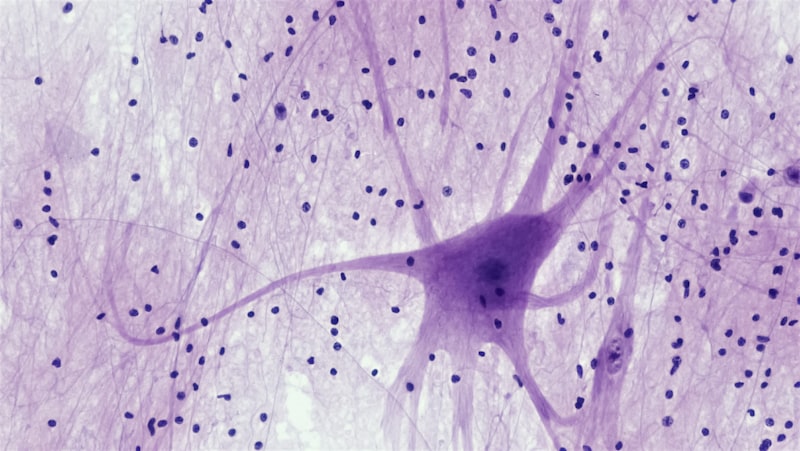
The differential staining achieved by the Nissl method is crucial for interpretation. While the cytoplasm, rich in RER and ribosomes, stains deeply purple or blue depending on the specific dye used, the neuronal nucleus typically remains relatively pale, with only the nucleolus staining intensely due to its high RNA and protein content. Furthermore, the specialized processes of the neuron—the axon and most of the dendrites—contain far fewer RER clusters than the soma and thus generally remain unstained or stain very faintly. This stark contrast allows researchers to accurately delineate the boundaries of the neuronal cell body, count the number of neurons within a defined area, and observe the internal state of the cell’s protein synthesis machinery. The intensity and distribution of the Nissl substance are direct indicators of the neuron’s metabolic activity; highly active neurons involved in rapid protein synthesis, necessary for growth or repair, typically exhibit more prominent Nissl bodies.
A key step in optimizing the staining outcome involves the process of differentiation. After the tissue sections are flooded with the basic dye, they are typically treated with a differentiating agent, often alcohol or an organic solvent. Differentiation works by selectively removing excess dye from non-specific binding sites and from components that bind the dye less tightly, such as the background neuropil and glial cell bodies. This controlled removal enhances the contrast, ensuring that only the most highly acidic structures—the Nissl bodies—retain the stain intensely. Careful control of this differentiation step is paramount; over-differentiation can lead to the complete loss of the stain, while under-differentiation results in a dark, indistinct background, obscuring the fine cellular detail necessary for accurate microscopic analysis. Thus, the successful application of the Nissl method requires precise execution, utilizing the chemical principles of acid-base interaction and controlled destaining to yield a clear, highly specific visualization of neuronal somata.
Methodology and Protocol
The application of the Nissl method follows a standardized histological protocol designed to preserve the delicate cellular structures while ensuring optimal dye penetration and retention. The initial and perhaps most critical step is tissue fixation, typically achieved using formalin, paraformaldehyde, or other aldehyde-based solutions. Proper fixation halts autolysis and stabilizes proteins and nucleic acids, preventing degradation and maintaining the morphological integrity of the neurons. Following fixation, the tissue is embedded, usually in paraffin wax or cryoprotected for frozen sectioning, and then sliced into thin sections ranging from approximately 5 to 20 micrometers using a microtome. The thickness of the section is crucial, as thinner sections provide finer resolution but risk fragmenting cell bodies, while thicker sections may obscure detail due to overlap.
Once sectioned, the slides undergo a process of preparation tailored to the embedding medium. For paraffin-embedded tissue, the slides must be deparaffinized using organic solvents like xylene, followed by a graded series of alcohol baths to rehydrate the tissue back to an aqueous state, preparing it for the water-soluble basic dye. The core step involves immersing the slides in the Nissl staining solution, often Cresyl Violet Acetate, for a specified period, allowing the chromophores to bind maximally to the RNA. Temperature and pH control of the staining solution are often regulated to optimize the binding efficiency and specificity, ensuring a reproducible result across different tissue batches. The duration of this staining phase can vary significantly depending on the concentration of the dye and the thickness of the tissue section being processed.
The subsequent steps are focused on enhancing contrast and preparing the slide for permanent mounting. After staining, the slides are briefly rinsed and then subjected to the crucial differentiation bath, often 95% ethanol or a solution containing acetic acid, which draws out non-specifically bound stain. This step requires microscopic monitoring to stop the differentiation precisely when the neuronal cell bodies are intensely stained but the background is adequately cleared. Once differentiated, the tissue must be completely dehydrated again through ascending concentrations of alcohol (e.g., 70%, 95%, 100%) to remove all traces of water. Finally, the sections are treated with a clearing agent, such as xylene, which makes the tissue transparent and miscible with the mounting medium. The entire protocol concludes with the application of a permanent mounting medium and the placement of a cover slip, sealing the section for long-term microscopic analysis and archival purposes.
Identification of Nissl Bodies and Cytological Significance
The term Nissl bodies refers to the distinct, granular clusters that stain intensely with the basic dyes of the Nissl method. These structures are not organelles in themselves but are histologically observable aggregates of the rough endoplasmic reticulum and polyribosomes. Under standard light microscopy, they appear as clumps or masses of deeply stained material distributed throughout the neuronal soma, extending into the proximal dendrites but notably absent from the axon hillock and the axon itself. The size, shape, and distribution pattern of Nissl bodies are highly characteristic of specific neuronal types, making the Nissl stain invaluable for identifying and classifying neurons, such as the large, prominent bodies seen in motor neurons compared to the finer, dust-like granules often observed in smaller interneurons.
The presence and morphological state of the Nissl bodies carry profound cytological significance, acting as a visible marker for the neuron’s physiological condition. Since these bodies represent the site of intensive protein synthesis—the RER synthesizes proteins destined for secretion or membrane insertion, and the polyribosomes produce cytosolic proteins—their appearance reflects the metabolic demands placed upon the cell. A robust, well-defined pattern of Nissl bodies indicates a healthy, metabolically active neuron capable of maintaining its structural integrity and functional output. Conversely, alterations in the normal distribution or structure of the Nissl bodies are often the earliest microscopic indicators of cellular stress, injury, or disease, a phenomenon critical to neuropathological diagnosis.
One of the key pathological changes observable using this method is chromolysis, a condition where the Nissl substance dissolves, disperses, or fragments, leading to the paleness of the cell body staining. Chromolysis is frequently observed following axonal injury (axotomy), during severe metabolic stress, or in neurodegenerative disorders. The dissolution of the previously granular Nissl bodies is thought to reflect a shift in the neuron’s protein synthesis priorities, often initiating a response aimed at regenerating the injured axon or coping with acute stress. By monitoring the changes in the Nissl profile—from healthy granularity to peripheral clumping or complete dissolution—researchers and clinicians can gain insight into the severity and type of cellular insult, demonstrating that the Nissl stain is far more than just a structural marker; it is a physiological barometer of neuronal health.
Applications in Neuroanatomy and Cytoarchitecture
The Nissl method serves as the cornerstone for the descriptive field of cytoarchitecture, which is the study of the cellular composition and arrangement of nervous tissue. By clearly outlining the boundaries of the neuronal somata and revealing their density, size, and spatial organization, the stain enables researchers to divide the brain into functionally distinct areas. Perhaps the most famous application involves the delineation of the six-layered structure of the cerebral cortex. Researchers, most notably Korbinian Brodmann, relied heavily on Nissl-stained sections to map out the cortical regions, demonstrating that subtle but consistent variations in the density and size of neurons within these layers corresponded to specific functional areas, leading to the establishment of the widely recognized Brodmann areas.
Beyond the cortex, the Nissl stain is indispensable for mapping subcortical structures, including the brainstem nuclei, the thalamus, and the basal ganglia. In these regions, nuclei are defined by distinct clusters of cells with uniform morphological characteristics, segregated from surrounding white matter tracts or other gray matter regions. The Nissl method allows for the reliable identification of these nuclear boundaries, providing essential anatomical references for experimental targeting and surgical planning. For instance, the identification of motor nuclei in the spinal cord and brainstem is routinely confirmed using Nissl staining, as the large, multipolar morphology of these neurons is highly visible and distinct when stained for their abundant Nissl substance. This ability to consistently define anatomical borders makes the technique a fundamental reference point for interpreting data derived from more complex functional or molecular assays.
Furthermore, the Nissl method is crucial for quantitative studies in neuroanatomy, particularly for neuronal counting. The clear demarcation of the cell body allows researchers to systematically count the total number of neurons within a specific brain region, a technique often employed in studies investigating age-related cell loss, the impact of toxins, or the effects of experimental lesions. While modern stereological methods have refined the accuracy of cell counting, the visual clarity provided by the Nissl stain remains the basis for identifying what constitutes a counting unit (i.e., a neuron). The combination of qualitative assessment (morphology and arrangement) and quantitative analysis (density and counts) ensures that the Nissl method remains a prerequisite for establishing the baseline anatomical context of almost any neuroscientific investigation.
The Role of Nissl Staining in Neuropathology
In the field of neuropathology, the Nissl method provides a relatively simple yet powerful diagnostic tool for assessing the health and integrity of neuronal populations in both experimental models and human post-mortem tissue. Because the stain is sensitive to metabolic disturbances, it is highly effective at revealing signs of acute injury or chronic neurodegenerative processes. Pathologists routinely use the Nissl stain to identify areas of neuronal loss, a hallmark of conditions such as stroke, Alzheimer’s disease, Parkinson’s disease, and various forms of trauma. Where healthy tissue shows a uniform density of stained cell bodies, pathological tissue often exhibits clear patches or laminar zones where neurons are absent or significantly depleted.
Beyond simple cell loss, the Nissl method is invaluable for detecting reactive cellular changes. For example, in cases of inflammation or injury, the stain can reveal signs of gliosis—the proliferation and activation of glial cells (astrocytes and microglia). While glial cells generally have smaller, less distinct nuclei and much less Nissl substance than neurons, the increased density of their nuclei in reactive areas is easily observed in Nissl-stained sections, signaling an immune or repair response in the nervous tissue. Furthermore, the stain is crucial for identifying specific pathological features within individual neurons, such as the aforementioned chromolysis, or the presence of inclusion bodies that displace the Nissl substance, though specialized stains are usually required for definitive identification of protein aggregates like neurofibrillary tangles.
The accessibility and reliability of the Nissl stain make it the primary screening tool in many neuropathology labs. It provides a comprehensive overview of the tissue structure, allowing pathologists to quickly identify regions of interest that require further investigation using more targeted immunohistochemical markers. For instance, if a Nissl stain reveals significant neuronal loss in the hippocampus, subsequent sections might be stained with antibodies targeting specific proteins indicative of Alzheimer’s disease. Thus, the Nissl method acts as a critical triage step, offering the essential anatomical context against which all subsequent molecular and pathological findings are evaluated, confirming its status as a foundational technique for understanding disease progression at the cellular level.
Limitations and Complementary Techniques
Despite its extensive utility, the Nissl method does possess inherent limitations rooted in its specificity. Its greatest strength—the specific staining of the RNA-rich soma—is also its primary drawback: it provides virtually no information regarding the complex dendritic trees, axonal pathways, or synaptic connections that define neuronal circuitry. The fine processes that connect neurons remain largely invisible, preventing a full understanding of the cell’s three-dimensional morphology and its functional interactions. Therefore, researchers seeking to map connectivity or analyze the morphology of dendritic spines must employ complementary techniques that visualize the entire cellular outline, rather than just the metabolically active core.
The most historically significant complementary technique is the Golgi method, also developed in the late 19th century. In stark contrast to the Nissl stain, the Golgi stain randomly impregnates only a small fraction of neurons, but it stains these selected cells completely, revealing the entire soma, dendrites, and axon in exquisite detail. The combination of Nissl and Golgi data often provides a complete picture: Nissl sections reveal the overall population density and cytoarchitecture, while Golgi sections offer the detailed morphology of individual cell types within that defined population. Modern approaches further integrate the Nissl stain with techniques such as immunohistochemistry, where specific proteins are tagged with fluorescent or enzymatic markers, providing molecular information atop the foundational anatomical context established by the Nissl stain.
Another limitation pertains to resolution and quantification. While useful for general cell counting, the Nissl method is based on light microscopy and cannot resolve subcellular structures smaller than the RER clumps. Moreover, the visual assessment of cell health based on chromolysis is inherently subjective, requiring experienced interpretation. Furthermore, when analyzing dense regions, the overlapping of cell bodies can lead to inaccuracies in counting. These limitations underscore the necessity of adopting modern techniques like electron microscopy for ultrastructural analysis or stereology for unbiased cell counting. Nevertheless, because it is cheap, robust, and provides a clear, permanent record of cellular arrangement, the Nissl method remains the critical first step in histological examination, providing the necessary context before deploying more resource-intensive or specialized imaging modalities.
Modern Adaptations and Legacy
While the fundamental chemical principle of the Nissl method remains unchanged, modern laboratories have developed several adaptations to integrate it seamlessly with contemporary research techniques. One common adaptation involves the use of fluorescent derivatives, such as NeuroTrace dyes (e.g., NeuroTrace 530/615), which are synthetic fluorescent molecules that mimic the binding properties of classical basic dyes. These fluorescent Nissl stains offer the advantage of compatibility with confocal microscopy and multi-channel imaging, allowing researchers to simultaneously visualize neuronal cell bodies alongside fluorescently tagged proteins or genetically expressed markers, greatly enhancing the depth of analysis within a single tissue section.
The enduring legacy of Franz Nissl’s contribution is reflected in its sustained relevance across diverse areas of neuroscience. Whether used for rapid quality control of tissue processing, for defining boundaries in stereotaxic atlases, or as a reference counterstain in complex molecular studies, the Nissl method provides the essential cellular map. In anatomical studies, it is often paired with tracing techniques, where the Nissl stain visualizes the general population while a tracer highlights specific projection pathways. In pathology, it continues to serve as the benchmark for diagnosing neuronal damage and assessing the extent of neuroprotection offered by experimental treatments.
In summary, the Nissl method, originally coined by Franz Nissl as the process used to stain neurons for microscopic examination, has transcended its origins to become a permanent fixture in neurohistology. It provides foundational insight into the cytoarchitecture of the brain by selectively staining the RNA-rich Nissl bodies within the neuronal soma. Its reliability and ability to reveal crucial information regarding metabolic activity, cell density, and structural organization ensure that, despite the advent of sophisticated molecular tools, the simple, elegant staining of the Nissl method will continue to be indispensable for preparing neurons for microscopic investigation and understanding the cellular organization of the central nervous system.