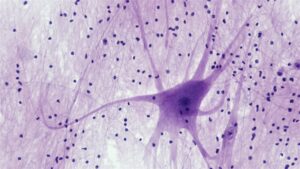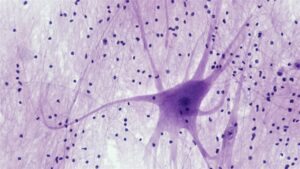
Tag: nerve cell


NEURON (Nerve Cell)

Introduction to the Neuron The neuron, universally recognized as the nerve cell, stands as the fundamental structural and functional unit of the nervous system. This complex cellular architecture is indispensable for the sensory perception, processing, and transmission of information throughout the body. The nervous system, encompassing the brain, spinal cord, and peripheral nerves, relies entirely […]

Read More

TERMINAL BUTTON

the terminal part of an axon from which a neural signal is rendered, via dispersion of a neurotransmitter, across a synapse to a nearby neuron TERMINAL BUTTON: “The terminal button is commonly referred to as the synaptic button, end button, button terminal, terminal bulb, and synaptic knob.”

Read More

CORTICAL NEURON

a nerve cell whose cellular structure is housed in the cerebral cortex. CORTICAL NEURON: “The cortical neuron can be found only in the cerebral cortex, nowhere else.”

Read More

MULTIPOLAR NEURON

Introduction and Definition of Multipolar Neurons The study of the nervous system relies heavily upon the accurate classification of its cellular components, the neurons, which are the fundamental units responsible for transmitting information. Among the diverse array of neuronal morphologies, the multipolar neuron stands out as the most prevalent type in the vertebrate nervous system, […]

Read More

PRESYNAPTIC

Definition and Fundamental Role The term presynaptic refers specifically to the neuronal component situated before the synaptic cleft—the microscopic gap separating two communicating neurons. Fundamentally, the presynaptic element is the specialized region of the axon terminal responsible for the initiation of chemical signaling across the synapse. This structure is paramount to neural communication, serving as […]

Read More

STELLATE CELL

Introduction and Definition The stellate cell, derived from the Latin term stella meaning star, is a fundamental type of neuron characterized by a symmetrically radiating dendritic arborization that gives the cell body, or soma, its distinctive star-like or polygonal appearance. Unlike pyramidal cells, which possess a single, dominant apical dendrite and are typically classified as […]

Read More