Tag: optical illusion


MOVEMENT ILLUSION

Historical Foundations of Movement Illusion Research The study of movement illusion—a perceptual phenomenon where a stationary object is perceived to be in motion—has a storied history that spans the evolution of human thought from classical philosophy to modern neuroscience. The earliest recorded observations of this phenomenon date back to the Greek philosopher Aristotle, who identified […]

Read More

OCULOGRAVIC ILLUSION

The Conceptual Framework of the Oculogravic Illusion The oculogravic illusion is a sophisticated optical phenomenon that describes the subjective experience of motion attributed to a stationary stimulus. Within the field of perceptual psychology, this illusion serves as a primary example of how the human visual system can misinterpret environmental data when subjected to specific conditions. […]

Read More

NECKER CUHE

Historical Origins and the Crystallographic Discovery of the Necker Cube The Necker Cube represents one of the most enduring and foundational stimuli in the history of perceptual psychology. It was first documented and described by the Swiss crystallographer Louis Albert Necker in 1832. Necker’s initial observation was not born out of a psychological experiment but […]

Read More

OCULOGYRAL ILLUSION

Definition and Core Concepts of the Oculogyral Illusion The oculogyral illusion is a complex perceptual phenomenon categorized within the field of vestibular psychology and aviation medicine, characterized by the apparent movement of a stationary visual object when the observer is subjected to angular acceleration. This illusion occurs because the brain receives conflicting signals from the […]

Read More

WINDMILL ILLUSION

Introduction and Definition The Windmill Illusion represents a compelling and extensively studied example of anomalous motion perception within the field of cognitive psychology and visual neuroscience. Categorized as a type of visual illusion, it manifests when a specific rotating pattern—typically resembling the vanes of a windmill or a radial grating—is observed, resulting in the perception […]

Read More

WATERFALL ILLUSION

The Waterfall Illusion: A Review of Visual Perception The Waterfall Illusion (often referred to generically as the Motion Aftereffect, or MAE, in psychological literature) stands as a seminal example within the study of visual perception. This classic phenomenon is characterized by the illusory perception of motion on a stationary surface immediately following prolonged viewing of […]

Read More

BENHAM’S TOP

Introduction to Benham’s Top and Historical Context The phenomenon known as Benham’s Top represents a classic intersection of physics, physiology, and psychology, serving as a powerful demonstration of how the human visual system processes temporal information. First popularized by the English toymaker and journalist Charles Benham in 1895, this simple device—a spinning disc featuring specific […]

Read More

MIILLER-LYER ILLUSION

Introduction to the Müller-Lyer Illusion The Müller-Lyer Illusion stands as one of the most celebrated and extensively studied phenomena within the field of visual perception, serving as a cornerstone for understanding how the brain processes spatial information and constructs a perceived reality. Although deceptively simple in its graphical representation, the illusion highlights fundamental ambiguities inherent […]

Read More

WUNDT CURVE

Defining the Wundt Curve: Perception and Illusion The Wundt Curve represents a compelling example of visual distortion and sensory adaptation, functioning as a specific form of visual aftereffect. It is fundamentally an optical illusion wherein the perception of straight lines is temporarily altered following exposure to an artificially warped visual field. Specifically, the phenomenon describes […]

Read More

RUBIN’S FIGURE

Introduction to Rubin’s Figure and Bistable Perception The psychological phenomenon known as Rubin’s Figure, often referred to simply as the Goblet Figure or Rubin’s Vase, stands as one of the most iconic and frequently cited examples in the study of visual perception. It is a quintessential demonstration of bistable perception, where a single, static two-dimensional […]

Read More

FLIGHT OF COLORS

Defining the Phenomenon of Flight of Colors The concept known as the Flight of Colors refers to a specific type of visual afterimage characterized by a dynamic succession of chromatic perceptions that occur immediately following the termination of an intense, brief visual stimulus, typically an extremely bright flash of white light. This phenomenon is categorized […]

Read More

MOVEMENT PERSPECTIVE

MOVEMENT PERSPECTIVE: The Perception of Motion, Distance, and Orientation The concept of movement perspective, often utilized within the study of visual perception and psychophysics, describes the orientation from which a moving object is being viewed and how this orientation fundamentally alters the observer’s perception of its velocity and distance. This perspective is not merely a […]

Read More

APPARENT MOVEMENT

Introduction and Definition of Apparent Movement Apparent movement, frequently referred to in psychological literature as illusory movement, constitutes a fundamental phenomenon within visual perception wherein a stationary observer perceives motion or a change in size when, in fact, no actual physical displacement of the object or scene has occurred. This powerful perceptual illusion is cued […]

Read More

ASSOCIATIVE ILLUSION

Defining the Associative Illusion The associative illusion represents a specialized category of perceptual error wherein an individual’s interpretation of a visual or sensory stimulus is fundamentally compromised by the complex and often unexpected interaction between distinct, separate components within the stimulus field. Unlike simple optical illusions, which may rely on distortion or physiological fatigue, the […]

Read More

PLATEAU’S SPIRAL

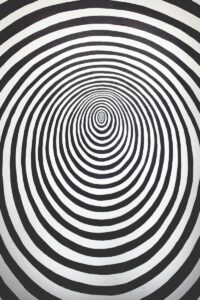
Introduction and Definition The concept known as the Plateau’s Spiral refers to a highly specialized visual stimulus utilized extensively within the field of perceptual psychology to elicit and study the phenomenon of the movement aftereffect (MAE). This stimulus is fundamentally composed of a black and white spiral design, meticulously rotated around its central axis. The […]

Read More

PENROSE TRIANGLE

The Definition of the Penrose Triangle and its Geometry The Penrose Triangle stands as one of the most celebrated and profound examples of an impossible figure within the study of visual perception and cognitive psychology. Fundamentally, it is a two-dimensional representation that depicts an object which cannot exist in a standard three-dimensional Euclidean space. The […]

Read More

AFTEREFFECT

Definition and Fundamental Characteristics The psychological phenomenon known as the aftereffect, often synonymously referred to as after-sensation or perceptual aftereffect, describes a modified perceptual experience that persists following the cessation of the original sensory stimulus. This transient alteration in perception is overwhelmingly studied within the visual domain, where extended exposure to a specific stimulant—such as […]

Read More

EMBEDDED FIGURE

Introduction to the Embedded Figure Concept The concept of the embedded figure lies at the intersection of visual perception and cognitive psychology, describing an element or shape that is obscured within a larger, more complex design. Unlike simple illusions where the figure-ground relationship is merely unstable, the embedded figure presents a deliberate challenge where the […]

Read More

KANIZSA FIGURE

The Kanizsa Figure is a foundational concept in the study of visual perception, specifically concerning the phenomenon of illusory or subjective contours. A Kanizsa Figure is defined as an optical illusion that induces the perception of distinct, clearly defined boundaries and shapes where no physical luminance differences or lines exist in the stimulus itself. These […]

Read More

DELBOEUF ILLUSION

Introduction to the Delboeuf Illusion The Delboeuf Illusion is a compelling example of a size contrast illusion, demonstrating how the perceived size of a central object is systematically distorted by its surrounding context. Specifically, this visual phenomenon involves two concentric circles: an inner target circle and an outer contextual ring, often referred to as the […]

Read More

AUBERT PHENOMENON

Introduction and Definitional Parameters The Aubert Phenomenon, also widely recognized in scientific literature as the Aubert Illusion, is a fundamental visual-vestibular illusion rooted in the psychophysics of spatial orientation. This phenomenon describes the compelling and consistent misperception of verticality that occurs when an observer views a vertical line while their head is physically tilted. Specifically, […]

Read More

STEREOGRAM

an image we see with depth using a stereoscope with 2 similar images in it. However, a stereoscope is usually used to view the images. Some of the observers may fuse 2 object images by crossing their eyes. STEREOGRAM: “A stereogram is what we see using a stereoscope but some people can see it by […]

Read More

AUTOKINETIC EFFECT

The Autokinetic Effect: A Visual Illusion of Perceived Motion The Autokinetic Effect, often referred to as the autokinetic illusion, is a profound and fascinating phenomenon in visual perception where a stationary, small point of light appears to move erratically when viewed in an otherwise completely dark environment. Derived from the Greek words auto (self) and […]

Read More

PHI PHENOMENON

Introduction and Definition of the Phi Phenomenon The Phi Phenomenon represents a foundational concept in the study of human visual perception, specifically relating to apparent motion. It is defined fundamentally as an optical illusion wherein an observer perceives continuous motion when, in reality, they are viewing only a succession of static visual stimuli presented rapidly […]

Read More

ANAGLYPH

Definition and Etymology of the Anaglyph The term anaglyph refers to a single composite image engineered from two slightly different perspectives of the exact same scene, which are printed or displayed superimposed upon one another using complementary colors, most commonly red and cyan. This unique visual construct is fundamentally dependent upon the principles of binocular […]

Read More

SIMULTANEOUS CONTRAST

Definition and Core Principles of Simultaneous Contrast Simultaneous contrast is a profound perceptual phenomenon defined as the enhanced perception of difference between two or more stimuli when they are presented concurrently and in close spatial proximity. This effect results in the exaggeration of perceived disparities in qualities such as color, luminance (brightness), saturation, or size, […]

Read More

SIZE-DISTANCE PARADOX

Defining the Size-Distance Paradox The Size-Distance Paradox refers to a significant and pervasive visual illusion wherein the perceived size of a known object is erroneously scaled based on its perceived distance from the observer, even when the object’s retinal image size remains objectively constant. This paradox highlights a fundamental complexity in human visual processing: the […]

Read More

PONZO ILLUSION

Introduction and Definition of the Ponzo Illusion The Ponzo illusion stands as a classic and widely studied example within the domain of geometric-optical illusions, demonstrating how the human visual system misinterprets the size of objects based on contextual background cues that suggest depth. Fundamentally, the illusion involves two identical horizontal line segments that are positioned […]

Read More

MOON ILLUSION

MOON ILLUSION The Core Definition The Moon Illusion is one of the most compelling and widely recognized perceptual phenomena in the field of Sensation and Perception. It refers to the striking visual paradox where the Moon appears significantly larger when it is viewed near the horizon, especially when framed by terrestrial objects such as trees […]

Read More

POGGENDORF ILLUSION

Poggendorf Illusion The Core Definition of the Poggendorf Illusion The Poggendorf Illusion is a classic and powerful example of a geometrical-optical visual illusion, wherein the human visual system misinterprets the alignment of diagonal lines that are intersected by an intervening figure, typically a rectangle or pair of parallel vertical lines. Fundamentally, this phenomenon causes the […]

Read More

ALLEY PROBLEM

The Alley Problem in Visual Perception The Core Definition and Mechanism The Alley Problem is a fundamental dilemma in Visual Perception and psychophysics that addresses the apparent convergence of parallel lines extending away from an observer into space. This phenomenon occurs when viewing structures known as collimate constructions—objects or arrangements that stretch out from the […]

Read More

LEONARDO’S PARADOX

Leonardo’s Paradox: Visual Perception and Wide-Angle Distortion The Core Definition of Leonardo’s Paradox Leonardo’s Paradox refers to an observed phenomenon in visual perception where elements known to be straight, particularly those situated at the margins or periphery of a wide visual field, appear conspicuously curved or bowed to the observer. This illusion is fundamentally tied […]

Read More

MACH] MACH-DVORAK STEREOILLUSION

The Mach-Dvorak Stereoillusion: Induced Depth Perception The Core Definition of the Stereoillusion The Mach-Dvorak Stereoillusion is a fascinating phenomenon within visual perception where two planar, two-dimensional images, which are identical in every physical aspect except for a slight difference in their orientation or tilt, are perceived by the observer as having significant depth and three-dimensional […]

Read More

ORBISON ILLUSION

The Orbison Illusion The Core Definition of the Orbison Illusion The Orbison Illusion is a compelling optical phenomenon that vividly demonstrates the brain’s active role in constructing visual reality from disparate sensory inputs. At its essence, this illusion involves the presentation of two distinct visual patterns that, when superimposed or viewed in a particular configuration, […]

Read More

SUCCESSIVE CONTRAST

Successive Contrast Introduction: Defining Successive Contrast Successive contrast is a fascinating type of optical illusion, a phenomenon where the perception of a current stimulus is significantly altered by preceding stimuli. This effect is not merely a trick of the eye but a fundamental aspect of how our brains process sensory information, particularly in the visual […]

Read More

REVERSIBLE FIGURE-GROUND

Reversible Figure-Ground Introduction: Defining Reversible Figure-Ground Reversible figure-ground is a fascinating optical illusion where the distinction between a perceived object (the “figure”) and its surrounding background (the “ground”) can spontaneously alternate, leading to multiple interpretations of the same visual stimulus. This phenomenon highlights the active, constructive nature of perception, demonstrating that what we see is […]

Read More